
Search
Additional Links Contact Us- Phone: (800) 423-4198
- Toll-Free: (815) 885-1900
- Email: [email protected]


ProMach is your partner from start to finish. Our product brands are grouped into distinct business lines that make the most sense to our customers, covering every function of the production line: Filling, Bottling & Capping, Decorative Labeling, Flexibles & Trays, Pharma, Handling & Sterilizing, Labeling & Coding, Robotics & End of Line, and Systems & Integration.
learn more


Sustainability pressures hit production lines, sourcing decisions, and cost structures. You’re expected to reduce material impact without compromising shelf life or machine performance. Many teams stall here because eco-friendly films can behave very differently under real operating conditions. The path forward becomes clearer when you connect material science with your equipment.
Here are some helpful tips for selecting sustainable pouch packaging films.
Sustainable films don’t fall into a single category. You’ll see options labeled recyclable, compostable, bio-based, or downgauged, and each one has tradeoffs. A recyclable structure may still rely on multi-layer barriers, while a compostable film may struggle with moisture resistance.
You need to define what sustainability means for your operation. Some teams prioritize recyclability within existing waste streams, while others focus on reducing overall material usage. When you align your goals with realistic outcomes, you avoid investing in films that sound good on paper but fail on the floor.
Barrier performance drives everything. If your film can’t protect against oxygen, moisture, or light, sustainability won’t matter because product loss wipes out any gains. You should start with product sensitivity and build outward.
Dry goods, liquids, and reactive ingredients all demand different film structures. A downgauged recyclable film might work for snack mixes but fall short for pharmaceutical applications. You’ll get better results when you map product behavior to film composition before you even consider environmental claims.
Sustainable films don’t always behave the same way on horizontal systems, and that difference shows up once production begins. Slight changes in stiffness or heat tolerance shift the film’s movement through the machine, affecting alignment and consistency. If the material doesn’t respond to heat and pressure, sealing becomes harder to control, and small variations become performance issues.
As those inconsistencies build, they begin to impact cut accuracy and output quality. What seems like a minor material adjustment can ripple through the entire process. Taking time to understand film helps you stay ahead of those challenges.
This is where collaboration with pouch packaging machine manufacturers becomes critical. They understand how newer film structures interact with forming stations, sealing jaws, and fill cycles. When you bring them into the conversation early, you reduce trial-and-error and avoid unnecessary downtime.
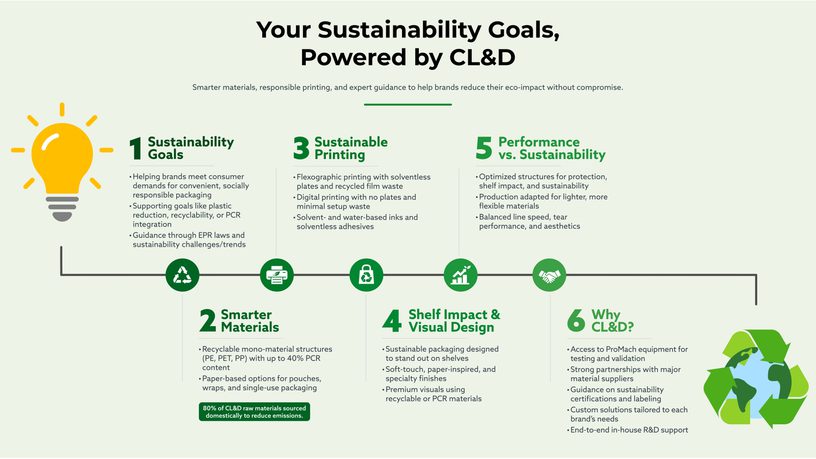
Working alongside material partners such as CL&D, a fellow ProMach brand, further strengthens this approach. By collaborating early to evaluate sustainable films, whether recyclable mono-material structures, PCR-integrated options, or paper-based alternatives, teams can account for real-world machine performance while balancing environmental goals. Testing films under production conditions, with printing and structure considerations factored in, helps ensure sustainability decisions translate into reliable, repeatable results on the line.
Seal quality determines whether your packaging succeeds or fails. Sustainable films often require tighter control over dwell time, temperature, and pressure. You can’t rely on legacy settings and expect consistent results.
You should test film response to:
These factors shape real-world performance. Strong seals come from dialing in the full process, not just selecting the right material.
Reducing material thickness sounds like an easy sustainability win, but it introduces new risks. Thinner films can stretch, wrinkle, or tear under tension if they don’t match your machine’s handling capabilities. You’ll also see changes in the way the film responds during forming and sealing.
You need to test downgauged options under production conditions. A film may pass lab testing but struggle during high-speed runs. When you strike the right balance, you cut material usage without sacrificing structural efficiency.
Sustainable films don’t just behave differently on the line—they respond to storage and transport conditions. Temperature swings, humidity, and extended storage time can alter seal response and handling. If your operation relies on bulk ordering or long lead times, those variables become more pronounced.
You’ll want to evaluate film performance from delivery through production, not just during active use. Factoring in these conditions helps you avoid inconsistencies that show up long before the film reaches your machine.
A film labeled recyclable doesn’t guarantee it fits into the current infrastructure. You need to look beyond the label and evaluate whether your target markets accept and process the material at scale. Regional differences in collection systems, sorting capabilities, and material acceptance can limit whether a film ever gets recycled in practice.
Mono-material structures have gained traction because they simplify sorting and improve the likelihood of recovery. Still, they require careful engineering to maintain barrier performance, especially for products with strict shelf life demands. When you align film selection with how recycling systems operate, you make decisions that hold up beyond the production floor.
Sustainable films often come with higher upfront costs, but focusing only on price per roll misses the bigger picture. Machine efficiency, waste reduction, and product protection all influence total cost. A cheaper film that causes downtime or spoilage costs you more.
You should evaluate cost across the full lifecycle. Pay attention to the film's effect on running speed, rejection rates, maintenance needs, and storage stability. When you take a broader view, the right sustainable choice becomes more obvious.
Switching films is an operational shift. Your team needs to monitor performance and refine processes. Training operators helps maintain consistency during the transition.
Start with controlled trials before scaling up. Document film behavior at different speeds and conditions. As you build familiarity, you’ll reduce variability and gain confidence in long-term performance.
You won’t solve sustainability in one decision. Film technology continues to evolve, and new materials keep entering the market. A strong strategy remains flexible and focuses on continuous improvement.
You’ve got more control here than it might seem at first. When you approach sustainable films for pouch packaging with a clear understanding of performance, compatibility, and long-term impact, you avoid costly missteps. Each decision builds toward a packaging system that supports both efficiency and environmental goals.
If you’re evaluating sustainable films for your current setup, working with a team like HMC Products can help you bridge the gap between material selection and machine performance. Our experience with horizontal systems gives you practical insight into how films behave in real production environments. Reach out to start a conversation about optimizing your packaging line for what comes next.