
Search
Additional Links Contact Us- Phone: (800) 423-4198
- Toll-Free: (815) 885-1900
- Email: [email protected]


ProMach is your partner from start to finish. Our product brands are grouped into distinct business lines that make the most sense to our customers, covering every function of the production line: Filling, Bottling & Capping, Decorative Labeling, Flexibles & Trays, Pharma, Handling & Sterilizing, Labeling & Coding, Robotics & End of Line, and Systems & Integration.
learn more


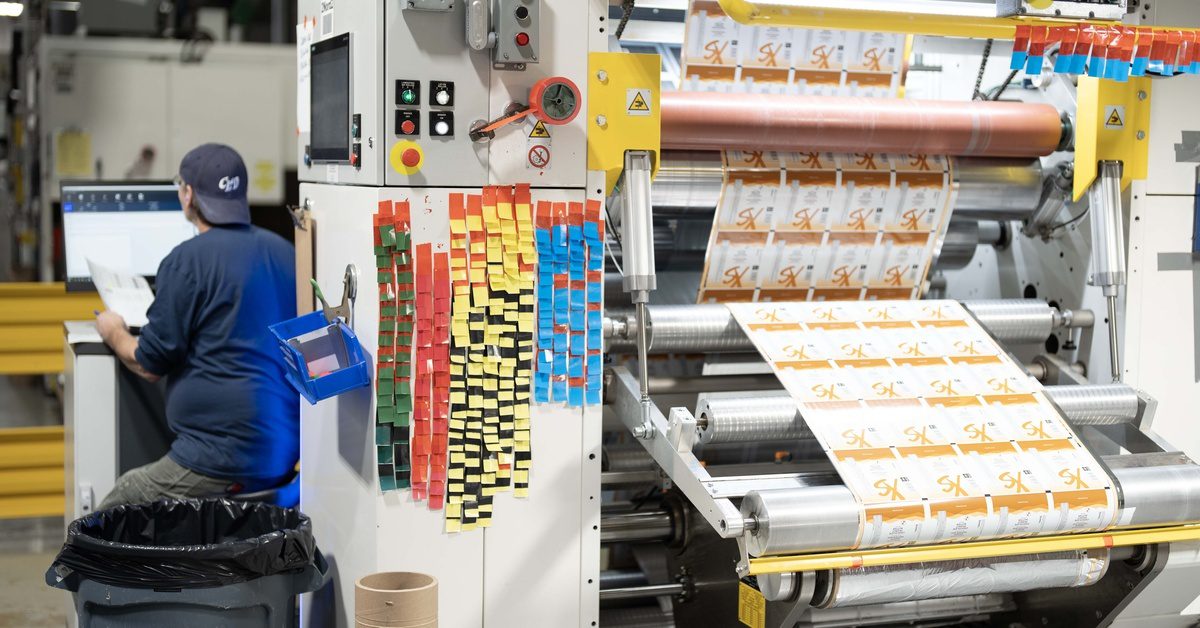
Print quality plays a direct role in packaging decisions. Many operations rely on processes that balance speed with consistency, yet few methods match the versatility they need. In this blog, we’ll explore what flexographic printing is and why it's important for modern packaging environments. You’ll see how it supports large-scale production while maintaining sharp, reliable results across different materials.
Flexographic printing relies on a rotary system that keeps materials moving at a consistent pace. Ink transfers from an anilox roller to the printing plate, then onto the substrate with precise control. Each color station aligns carefully, so the final image appears sharp and balanced. Operators fine-tune pressure and ink volume with drying conditions to maintain uniform output.
Flexographic printing stands out because it combines adaptability with production speed. It supports long runs while keeping image quality consistent, even across different packaging materials. That balance helps manufacturers maintain branding standards without slowing output. The following benefits highlight why many operations rely on this method:
Flexographic printing works across flexible packaging materials that demand durability and visual clarity. Films used for pouches, wraps, and sachets move smoothly through presses while holding ink effectively. Foils provide barrier protection while still accepting detailed print layers. Paper-based materials also benefit from the process, especially in applications where branding and readability matter.
This versatility connects directly to packaging systems such as a horizontal form fill seal machine, which are ideal for high-output environments. Printed rollstock films feed directly into the system, so alignment and clarity must remain consistent. When printing quality holds steady, packaging performance improves across every stage.
Ink plays a central role in flexographic printing, with distinct formulations tailored to different materials. Water-based inks support sustainability goals while still delivering strong color performance. Solvent-based inks provide durability on films and foils, especially in demanding environments. UV-curable inks add another layer of precision with rapid curing under controlled light exposure.
Drying systems match the ink type to prevent smearing and maintain production speed. Heated air, infrared systems, or UV lamps complete the curing process as the substrate moves forward. Each method supports a specific balance between speed and finish quality. Strong drying control keeps colors vibrant while preventing defects during high-speed runs.

Flexographic printing supports packaging efficiency by aligning closely with automated production systems. As materials move from printing to forming and sealing, consistency becomes critical. Clear graphics, accurate registration, and durable ink adhesion all contribute to fewer errors during packaging.
Moreover, the process supports continuous operation, which keeps output levels stable across long shifts. Teams spend less time correcting print inconsistencies and more time maintaining flow. That stability becomes especially valuable in industries that handle large product volumes.
Precise registration keeps each color layer aligned, which directly affects the final appearance. Sensors and control systems monitor alignment throughout the run, adjusting as needed to maintain accuracy. Even slight shifts can impact readability and branding, so control systems are vital. Reliable registration protects both product presentation and compliance requirements.
Color consistency also supports brand recognition across packaging lines. Standardized ink formulations and calibration routines help maintain uniform results. Operators monitor density and tone throughout production to avoid variation.
Flexographic printing appears across multiple industries because it adapts to different packaging needs. Food packaging relies on it for clear labeling and durable graphics that withstand handling. Pharmaceutical products depend on precise print for compliance and traceability. Household goods and personal care items also benefit from high-quality, consistent packaging visuals.
Each application places different demands on materials and print quality. Flexible films used in food packaging require strong adhesion and resistance to moisture. Pharmaceutical packaging demands sharp text and accurate color for labeling clarity. Across all these uses, the process delivers reliable results that support function and presentation.
Flexographic printing delivers strong performance, yet it still presents challenges that require attention. Plate creation takes time and requires precision, especially for detailed designs. Initial setup costs can run higher compared to simpler printing methods. Operators must also manage ink viscosity and drying conditions carefully to maintain quality.
Despite these challenges, most issues become manageable through proper setup and training. Advanced equipment and monitoring systems help maintain consistency throughout production. Teams that invest in calibration and maintenance see fewer disruptions.
Flexographic printing competes with other processes such as digital and gravure printing. Each method serves a different purpose depending on production needs. Flexography stands out in high-volume environments where speed and consistency drive performance. Digital printing offers flexibility for shorter runs, while gravure excels in ultra-high-quality applications.
This comparison highlights why flexography remains widely used in packaging. It bridges the gap between speed and quality without limiting material options. For many manufacturers, that balance supports operational goals and brand standards. As packaging demands continue to evolve, this method holds a strong position in the industry.

Selecting the right flexographic setup requires careful consideration of production needs. Equipment configuration, ink systems, and substrate compatibility all influence the results. Operations benefit from aligning printing capabilities with packaging machinery to maintain consistency.
The following factors help guide decision-making when evaluating a flexographic setup:
Optimizing a high-speed packaging line requires looking at materials and machinery as a single, integrated system rather than two separate components. When the printed film and the packaging equipment are engineered in isolation, operations frequently encounter issues on the plant floor, such as incorrect film tension, jaw-sticking, or inconsistent eye-mark registration.
To eliminate these integration bottlenecks, HMC Products works directly with fellow ProMach flexible packaging partner, CL&D. As a dedicated flexographic printer specializing in high-performance roll stock, CL&D engineers film structures, inks, and surface treatments to match the exact mechanical tolerances of automated packaging lines.
For manufacturing teams, this collaboration simplifies the procurement and testing workflow. Instead of managing separate technical communications between a printer and an OEM, operations gain a unified engineering channel that stabilizes the film web from the initial print run all the way through the final seal.
Flexographic printing continues to shape modern packaging because it balances efficiency with adaptability. High-speed output supports large-scale production while maintaining consistent visual quality. This combination strengthens branding, improves workflow, and reduces production setbacks. As packaging demands grow more complex, this method continues to meet those challenges.
HMC Products supports packaging systems that rely on consistent, high-quality printed materials, backed by expertise in pouch machinery and production support. If you’re evaluating ways to improve packaging performance, now’s the time to explore how printing and machinery align within your operation. Reach out and take the next step toward a more efficient production line.